
Food Application Lab
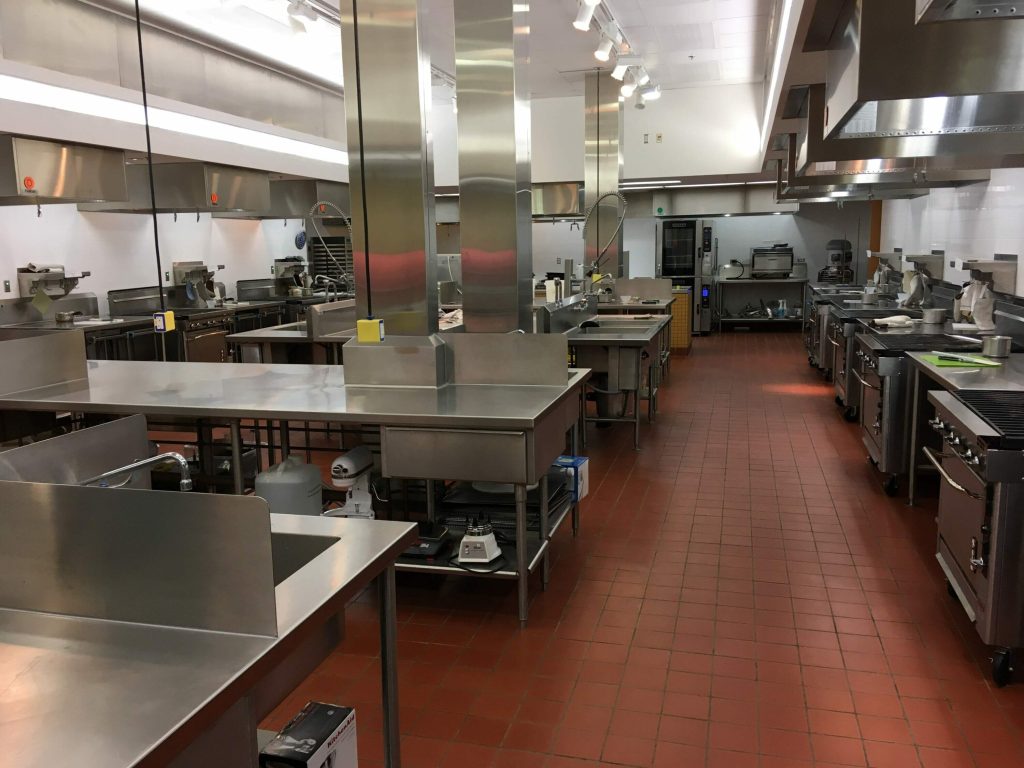
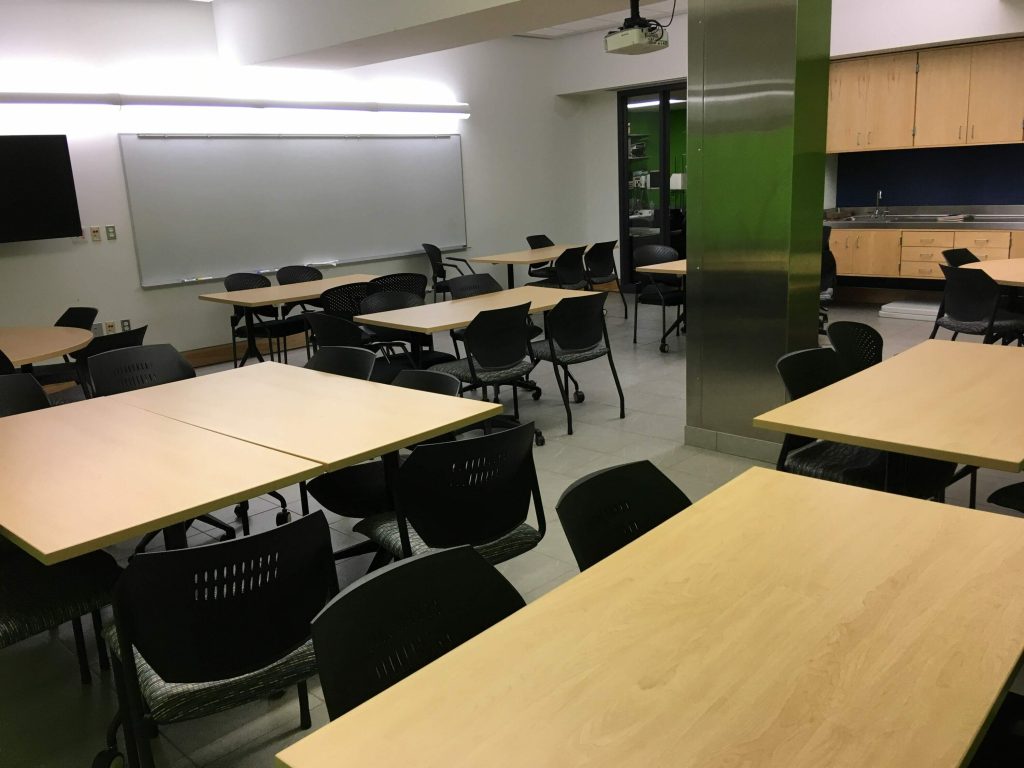
This lab has 11 culinary workstations, a lecture room, food service equipment, a dishwashing and cart washing area, a resource area, dry storage, refrigerated and frozen storage, as well as a hand washing area and student lockers.
Food preparation for both small scale and food service scale is possible with our ample counter space and food service equipment.
For more information, contact Nicholas Smith at nsmith35@wisc.edu.
Pilot Plant
The Department of Food and Nutritional Sciences maintains three pilot plant facilities that are available on a fee-for-service basis for general food product processing studies as well as equipment and process evaluations. There is a variety of equipment (kettles, tanks, retorts, mixing devices, cookers, heat exchangers, pumps, etc.) already available in the department, and all of the major utilities exist to allow for most types of processes and equipment.
Current pilot plant processing capabilities include:
- Confectionery
- Fruit and vegetable
- General food and dairy
View the list of available pilot plant equipment.
For more information on available equipment, services, scheduling, etc., contact Marshall Laechelin, pilot plant manager, at laechelin@wisc.edu.
Sensory Lab
Located in Babcock Hall, the Sensory Analysis Laboratory has:
- A diverse pool of panelists readily available for participation in sensory panels
- Consumer preference evaluations conducted at the Dairy Products Salesroom, UW-Madison
- Proximity to the Department of Food and Nutritional Sciences, allowing sensory analysis data to be integrated with the problem-solving facilities of a gas and high-performance liquid chromatography laboratory. Integration of these services to form mini-research projects is available.
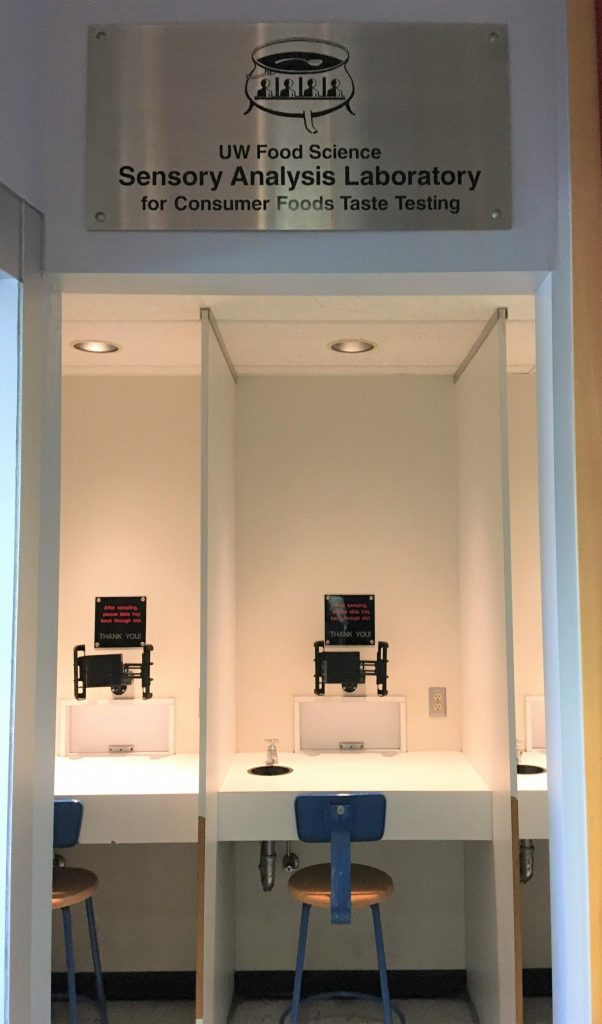
Consumer and sensory testing is about a person’s sense of taste, smell, touch, sound and sight from their perception of food. In a taste panel, these senses can be measured scientifically to obtain information about particular aspects of a food. Difference testing determines if samples are perceived to be different, while the consumer preference testing determines product acceptability utilizing untrained consumers.
When conducting a taste panel, food is uniformly prepared and presented to panelists in isolated booths. They record evaluations of the product on a ballot, which is decoded and analyzed by statistical procedures. A full comprehensive report is available one week after the test, including interpretive findings based on data.
Our Facilities
- Isolated taste panel booths
- Variable lighting conditions
- Equipment for the preparations and service of a wide variety of food products
- Charges for services offered are calculated on a cost-recovery basis and are extremely competitive. Collected fees go back to the department supporting student programs and research.